

If you are weighing up braces for yourself or your child, knowing the different types of braces available makes the decision far less daunting. Brackets, wires and aligners have all changed a lot over the past decade, and the option that suits a nine year old with a developing bite is rarely the one that suits an adult who wants treatment nobody notices. Here is a plain look at each option and who it tends to work best for.
What braces options are available?
Modern orthodontic advances make it possible for people of all ages to get braces that work for their individual concerns and lifestyles. At Sawgrass Orthodontics, we offer a range of options.
Metal braces
These are the most common type of braces for patients of all ages. Metal braces use stainless steel brackets, an archwire and small elastic bands to move your teeth, and today’s brackets are noticeably smaller and more comfortable than the ones most parents remember. They handle the widest range of cases, including severe crowding and bite correction, which is why they remain the most prescribed option year after year.
Ceramic braces
Ceramic braces work exactly like metal ones, but the brackets are made from a clear or tooth-coloured ceramic instead of steel. They blend against the enamel, so they are far less obvious in photos and conversation. The trade-off is that the brackets are slightly larger and more brittle than metal, so we tend to recommend them for older teens and adults rather than younger patients still in contact sports.
Self-ligating braces
Self-ligating braces are a different mechanism rather than a different material. Instead of an elastic band holding the wire against each bracket, a built-in clip does the job. Less friction between wire and bracket can mean gentler tooth movement and fewer adjustment appointments. Self-ligating brackets come in both metal and ceramic, so you are not choosing between a discreet look and this mechanism. You can have both.
In-Ovation®
In-Ovation® is the self-ligating system we use. It relies on that same clip design to hold the wire in place, which often means shorter appointments and less chair time overall. It suits patients of all ages and works particularly well for anyone whose schedule makes frequent visits difficult.
Lingual braces
Lingual braces are fixed to the back surfaces of the teeth rather than the front, which makes them essentially invisible from the outside. They are the most discreet fixed option available and are usually chosen by adults in client-facing work. They take a little longer to adapt to, since the brackets sit against the tongue, and most patients find speech returns to normal within a couple of weeks.
Clear aligners
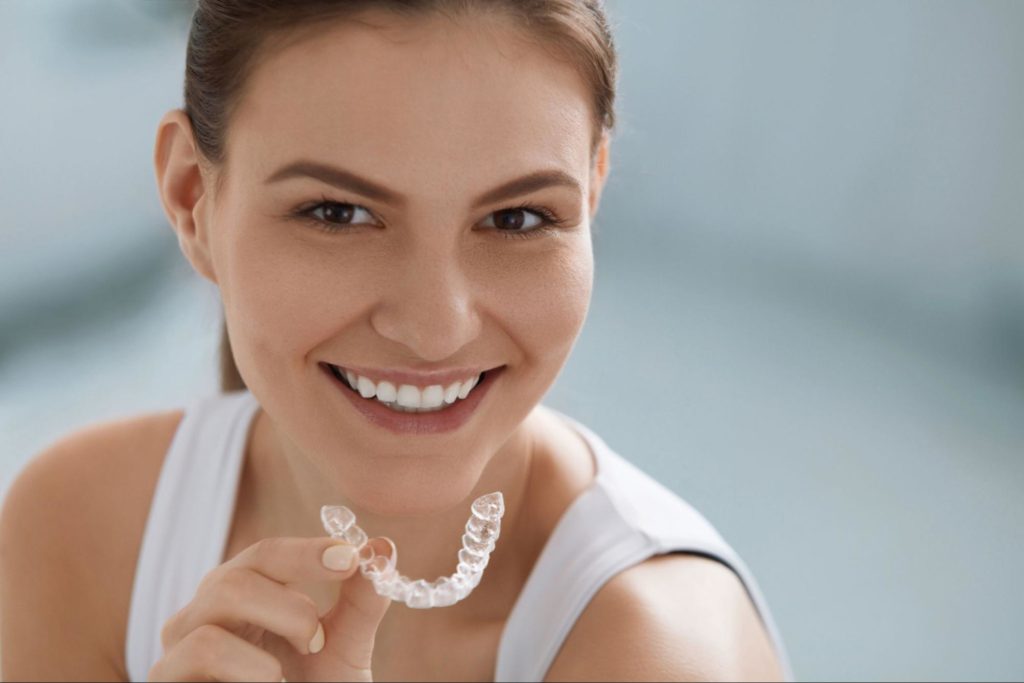
Invisalign is a strong choice if you want straighter teeth without the look of fixed braces. A series of clear plastic trays fits snugly over your teeth and moves them gradually, with each tray worn around 20 to 22 hours a day and swapped for the next every one to two weeks. Because they come out for meals and brushing, there are no food restrictions and hygiene is straightforward. The catch is compliance. Aligners only work when they are actually in your mouth.
How do I know which type of braces is right for me?
Most of the time the answer comes down to a blend of clinical need and personal preference. Age matters, because a growing jaw responds differently to a fully developed one. So does the severity of the issue, since a mild crowding case opens up options that a significant bite problem does not.
- Metal braces suit younger children with developing bones and teeth, and they are our usual recommendation for complex cases and severe bite issues at any age.
- Ceramic braces suit adults and older teens who want the same result as metal but with a far less visible bracket.
- Self-ligating and In-Ovation® suit patients of all ages, and particularly anyone who wants to minimise the number of adjustment visits.
- Lingual braces suit adults and teens who want fixed treatment that genuinely cannot be seen.
- Clear aligners suit older teenagers and adults with mild to moderate concerns who are prepared to wear them consistently.
These are general patterns rather than rules. In some cases we combine treatments, pairing fixed braces with an appliance such as Forsus to correct jaw alignment alongside tooth movement. During your consultation, Dr. Kristen and Dr. Penny will walk through which approach fits your situation.
Common questions about the different types of braces
Which type of braces works fastest?
Speed depends far more on the complexity of your case than on the bracket you choose. Metal braces often move teeth efficiently in difficult cases, and self-ligating systems can reduce the number of adjustment visits along the way. Your orthodontist will give you a realistic treatment timeline once your records are reviewed.
Are ceramic braces the same as self-ligating braces?
No. Ceramic describes what the bracket is made of and self-ligating describes how the wire is held in place. A bracket can be one, the other, both or neither.
Can adults get any type of braces?
Yes. Every option here is available to adults, and the discreet options tend to be the most popular. The only real limits are clinical, and your orthodontist will tell you at your consultation if a particular option will not achieve the result you want.
Do all braces need a retainer afterwards?
Yes, without exception. Teeth drift back toward their old positions once the pressure stops, so a retainer is what protects the result you spent months achieving.
Which type of braces is best for teenagers?
It depends on the case and on the teenager. Metal braces handle complexity and need no daily discipline, while aligners offer flexibility for teens who will genuinely wear them. We cover this in more detail in our guide to orthodontics for teens.
Sawgrass Orthodontics has braces for all ages
Whatever your age or concern, our team will help you work out which of the different types of braces fits your smile and your life. Contact us to book a free consultation today.
Back to Blog